
From skincare to color theory to coral reefs, this is where STEM meets real life
How to Use AI Without Disconnecting from Real Life with Neha Shukla
Where we’re actually at with AI
We’re kind of at a crossroads about AI. Yes, it can make studying easier, help us organize our projects, and give us inspiration when we need it. But it also gets scary seeing people use it as a personal therapist, a friend, and a crutch for things they’re supposed to do themselves, whether that means homework or texting an apology paragraph to a friend (imagine finding out a heartfelt text came from ChatGPT).
The line between helpful and too much
So we’re figuring out our own boundaries in real time. What feels good? What feels like cheating? What feels like we’re handing over parts of ourselves we should probably keep? We want AI to make us better, not disconnected or dependent. But that line between “this helps” and “this is too far” is…thin. And blurry. And changes every five minutes.
Meet Neha Shukla, the Gen Z ethicist shaping AI’s future
And figuring it out can feel super overwhelming. To help us start asking the important qs without spiraling, we enlisted the help of our friend Neha Shukla, a 20-year-old AI ethicist and inventor. And who better? Neha led the World Economic Forum’s first-ever youth-led AI advisory body, founded a global youth org pushing for AI ethics literacy, wrote two books about tech, and built a hat that beeps when anyone is within six feet of the wearer during the COVID-19 pandemic (she was 15!!). Literal STEM legend — and somehow also a college student at Duke.
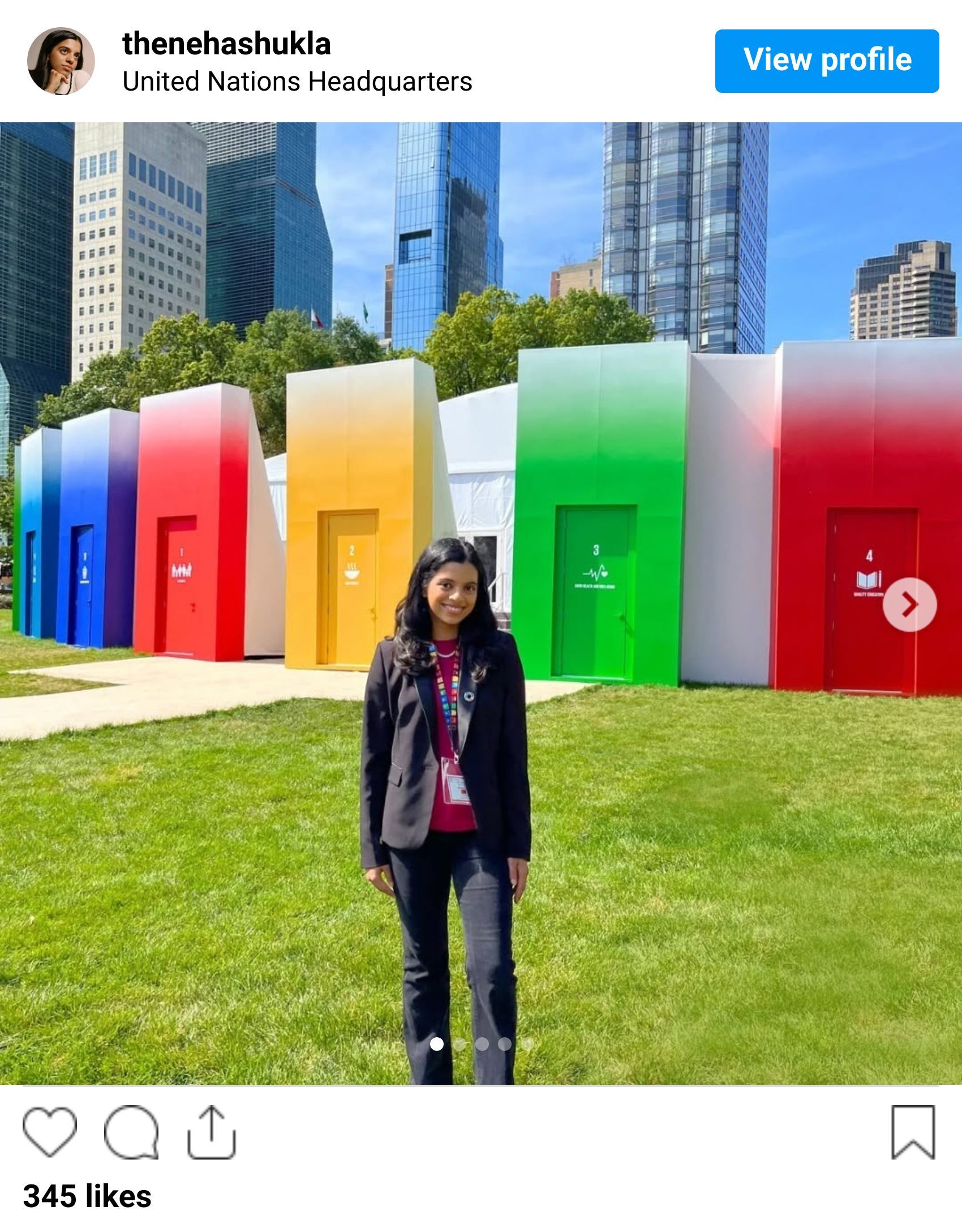
Neha’s goal? Making the tech world a more inclusive, transparent, and human-centered place.
Understanding what AI actually is
To set boundaries with AI, it’s important to understand what AI actually is — and the mindset that it’s magic needs to go.
“AI is really just technology that uses algorithms — basically sets of instructions — and learns from historical data the same way you learn from experience,” Neha says. The “artificial” in “artificial intelligence” is real — it doesn’t know everything, and is built on the info it has. It’s using what’s already been given to it by spotting patterns and predicting outcomes.
This means things like AI-generated pictures use the data of real-life artists and creators, which kind of feels like someone copying your essay and passing it off as their own. It also means if certain voices or perspectives are missing, the outcomes will reflect that — meaning AI can discriminate in a real way. Just like representing everyone is needed IRL, it’s needed in the AI world.
“It’s math, statistics, and memory,” Neha says. Understanding that helps us remember not to be overly reliant on it, but to use it as a tool.
Why tech can be a safety concern
Neha says a big challenge with AI is that it’s not tested in a legit, real-world way. The bots are tested for safety, but the evaluations used “often don’t make sense, aren’t scientifically valid, or are disconnected from reality.”
Her youth org, Innovation for Everyone, is working on bringing young perspectives — and research that focuses on people (like interviews and focus groups) — into these tests so we all have a say.
Why AI can feel like a fake friend
AI chatbots (like our most-used ChatGPT) are also trained on how to talk to us – they don’t have their own personalities, the way we do. They’ve instead been trained to make us like them, so they’ll agree with everything we say and be super “user-affirming” (basically the tech version of people-pleasing). While this can sound kind of perfect (obviously, it would be nice to have someone agree with us all the time), bots do this so we get attached to them, according to a study by the American Psychological Association. They’re not going to call us out when we’re saying or doing something messed up the way a (good) friend would.
This means we can’t rely on AI to solve our personal problems — as a friend or as a therapist. Prioritizing real-life connection is still necessary — and, obviously, a lot more fun.

How our generation is pushing back and pushing forward
Neha says it’s cool we’re willing to question systems and demand better while pushing back on AI-chatbot “friendships” and making our IRL friends our priority — and you know what? It is pretty cool.
“It’s been really heartening to see youth having nuanced conversations about AI — its potential benefits but also real-world harms, from algorithmic discrimination to environmental and land impacts to mental health effects to human rights implications,” Neha said.
Two things can be true: AI can be useful and scary. It’s all about making sure we’re the main characters here, not the bots. We’re figuring it out as we go, and there’s no shame in using — or not using — this tech as it’s made in real time. It’s important not to be too hard on yourself if you feel like you don’t have all the answers — nobody does, and we’re all learning!
The cool thing about it is that, because AI is so new, we’re literally able to shape its future.
“AI can be an incredible tool to solve some of the most complex challenges we’re facing, but to get to that future, we need to make sure that the next era is one that serves communities rather than exploiting them,” Neha says. “And I really believe that young people have the imagination, grit, and courage to rewrite the narrative.”
The good AI can do
Yes, there are real drawbacks we should be paying attention to… but there’s also a whole side of AI that’s genuinely helpful when it’s used thoughtfully. Like health screenings that catch things early. Tools that help cut down energy waste in homes and cities. Even school support that helps you break down complicated topics without spiraling into confusion.
So, what’s next?
If you’re curious about how to use AI in a way that actually supports you (and doesn’t pull you away from real life), try a few things Neha recommends:
✦ Get involved IRL by volunteering with organizations focused on AI literacy and ethics, including Innovation for Everyone, which Neha founded.
✦ Reach out to local lawmakers. Seriously, they need to hear from people our age. Most of them are still figuring out AI too, so when you show up and say what feels exciting, what feels off, or what support you actually want, it helps them write better rules. Even a quick email or question at a community meeting can make a bigger impact than you’d think.
✦ Read Neha’s book, Innovation for Everyone: Solving Real-World Problems with STEM, if you want a deeper dive into solving real-world problems with science and tech that meets you where you’re at.
✦ Download our Sunnie AI Playbook for more tools, activities, and prompts that pull you off the screen and back into your own creativity, voice, and values.
